Croft History
  • Home
  • Places of Worship
  • Local Families
    • The Yates Family
    • The Clare, Warburton and Daintith Family
  • World War Two
  • Gallery
  • Public Houses
  • News
  • Burial Grounds

History
&
​Heritage

Chat Moss & The Liverpool and Manchester Railway

28/8/2023


Manchester Mercury
Tuesday 3rd September 1822

​Notice is hereby given, that application is intended to made to Parliament, in the next Sessions, for leave to bring in a Bill, to make a rail or tram road or roads into, through, to and from the town and borough of Liverpool, into, through, to and from the town of Manchester, both in the county palatine of Lancaster, with certain branch rail or trans road or roads to be connected therewith, and that the same is, or are intended to pass into, through, to, and from the several boroughs, parishes, townships, and places of Liverpool, Everton, Kirkdale, Walton, Wavertree, Childwall, West Derby, Knowsley, Prescot, Huyton or Highton, Whiston, Cronton, Torbock, Rainhill, Eccliston, Saint Helens, Sutton, Parr, Haydock, bold, Burton Wood, Newton-in-the-Willows, Winwick, Leigh, Kenyon, Croft, Culcheth, Astley, Chat Moss, Wooding, Worsley, Barton-upon-Irwell, Swinton or Winton, Monton, Eccles, Pendleton, Salford, and Manchester, in the county palatine of Lancaster, or some of them.
Dated the twenty-eighth day of August, one thousand eight hundred and twenty-two.
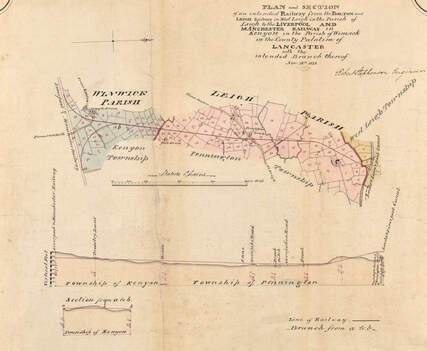
Old manuscript map of railway
1828 Plan showing a proposed railway line and signed by Robert Stephenson. Picture courtesy of Parliamentary Archives

Chat Moss

One of the most famous of the railway engineering works was Stephenson's 'floating' railway across Chat Moss, an undertaking that one contemporary engineer declared 'no man in his senses would attempt'.
 
The bleak waste of Chat Moss had long been notorious in the county of Lancashire. It had defied several attempts over the years to drain and cultivate it and was home to vipers. A giant spongy mass of bog-moss, it rose above the surrounding countryside like the dome of a giant jellyfish.
 
The treacherous bog would not bear the weight of either a man or a horse; it was over 30ft deep in some places, and four miles across. Stephenson's assistant John Dixon slipped off a wooden plank while inspecting the ground, and nearly disappeared for good; he had to be rescued by the navvies.
 
The engineers and men approached the problem logically. The navvies fastened wooden boards to their shoes to spread out their weight and stop them sinking; next, they constructed heather walkways for their wheelbarrows and the wagons. Light rails were laid down on this path. Young lads pushed one-ton wagons laden with building materials along the rails, and according to Stephenson's biographer Samuel Smiles, they could trot across all four miles of the Moss in just over half an hour.
 
Stephenson ordered drains to be cut on either side of the track route; around 200 men were needed for this section. It was frustrating work; in many places, whenever the men dug a drain, the Moss quickly filled it up with water again. So a kind of 'pipe' drain was constructed using empty tar barrels joined end to end, weighted down with clay so they wouldn't rise up again. But the railway line, of course, had to support the weight of a full-size locomotive and wagons. Once the ground had firmed sufficiently after drainage, hurdles 9ft wide and 4ft broad, interspersed with heather, formed a kind of floating base. A 2ft layer of gravel or ballast was piled on this, topped by wooden sleepers, on which the track was laid. 
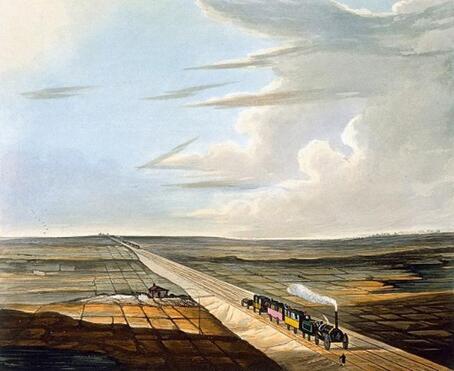
PictureView of the Railway Across Chat Moss, 1831
View of the Railway Across Chat Moss, 1831. Engraved by Henry Pyall after a painting by Thomas Talbot Bury
To the dismay of the men and the railway directors, and despite all their efforts to prevent it, the Moss swiftly gobbled up whole sections of their new embankment. Worst of all was the embankment which had to support the line at the Manchester end of the bog. Turf-cutters, men and boys, skinned the moss nearby with sharp spades called 'tommy-spades', and dried the turf into cakes, which were then tipped into the hole to help form the embankment. The men tipped in hundreds of wagonloads of dry moss in order to fill it up, to no avail; it seemed as if they were feeding a bottomless pit.

​The tipping went on for weeks, but Stephenson encouraged the men to persevere. They worked day and night until at last the Moss was conquered; his vision of a floating railway was now a reality, and a lasting monument to the navvies hard work.
£28,000 (£2.6 million today) was the total cost for the Chat Moss crossing - £820,000 (£77 million today) being the cost for the whole railway.

The Opening of the Railway

Before the official opening of the Liverpool & Manchester Railway, there was much controversy over which design of locomotive to use. The story of the Rainhill trials in October 1829 and the triumph of Stephenson's Rocket is well known. Rocket achieved a then revolutionary speed of 29mph (unladen) and won the £ 500 prize.

The next year an 'immense multitude' gathered to witness the grand opening ceremony at Liverpool on 15th September; the cheering crowds saw the wonderful engines, covered with flags and carrying many passengers, speed down the line with 'arrow-like swiftness'.
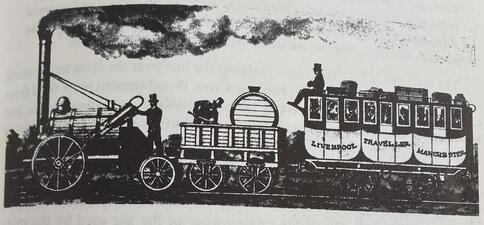
Robert Stephenson's Rocket
Stephenson's Locomotive, Rocket
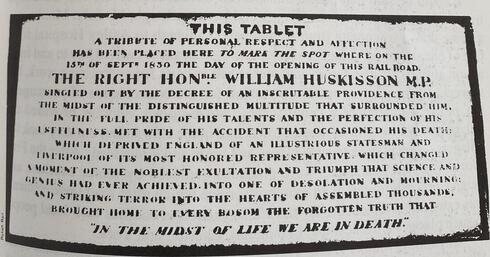
​The day was marred by a dreadful accident at Parkside, when William Huskisson, M P for Liverpool, unluckily fell under the wheels of the advancing Rocket, and was fatally injured. The Duke of Wellington wanted the festivities cancelled, but after much hand-wringing by the authorities and railway directors, fears over public order meant the procession of engines eventually continued their journey to Manchester. Here they received a mixed reception as political protestors tried to make their presence felt. Radical sympathisers waved banners and some of the wagons had stones thrown at them by weavers. A tablet was later displayed in his memory.
Picture of a memorial tablet
Tablet dedicated to William Huskisson
The railway opened to passenger traffic the next day, conveying 130 people to Manchester for seven shillings a head, in an hour and thirty-two minutes.

​The Railway Age was here.

​(Extracted and edited from NARROW WINDOWS, NARROW LIVES by Sue Wilkes)

Ancient Crosses in Irlam and Cadishead

4/8/2023


Myth or Legend?

I recently read a story written in the mid 20th Century that the Crossfield Estate in Irlam was so-called because it was the site of one of many ancient crosses leading the way to the nearest church.
Having not seen any evidence for this, I set out to research this story and see what I could find out.

I came across a volume of The Manchester and Lancashire Antiquarian Society from 1904 and found within a detailed chapter which is probably the source of this story. The facts speak for themselves - this 'could' be the case, but there isn't really any evidence for it. However, the chapter is very interesting to any local inhabitants.

The Transactions of the Lancashire and Cheshire Antiquarian Society Vol.XXll-1904
The Ancient Crosses of Lancashire-The Hundred of Salford
​by Henry Taylor

A series of crosses once stood on the principal roads leading out of some of the ancient towns of the county, as at Preston and Ulverston. Such a series apparently once existed on the old road from Manchester through Pendleton to Eccles, Patricroft, and beyond.

It is not improbable that several of them were erected for devotional purposes. In mediaeval times, and especially after the Wars of the Roses, ruffianly robbers filled the country districts, bent on the plunder of merchants, who it is well known often prayed for a safe journey at wayside crosses.
 
I assume that the first cross stood on White Cross Bank, one mile west of the Manchester marketplace. The next would be at the end of Cross Lane, half a mile west from the preceding. Another half mile would bring the traveller to Pendleton Green, on which a cross stood before the present church was built.

Eccles is two miles beyond Pendleton, and here were two crosses in the marketplace. There may have been others between these villages. Patricroft is a mile west from Eccles. In all probability a cross, dedicated to St. Patrick, once stood here.

Proceeding from Patricroft, on the ancient road to Warrington, Barton Old Hall is reached at a distance of a full half mile. The ancient cross discovered here by Mr. Rowbotham is described later in these pages. The site of another cross is probably recorded by the words ''Cross Field," which we find on the ordnance map on the north side of this road-two miles south-west from Barton Cross and about half a mile short of the village of Higher Irlam.

This road skirts the vast morass called Chat Moss, a dangerous place for travellers in the old times, and this cross (and possibly others of which there is now no record) may have been placed here as guides to travellers.
Picture
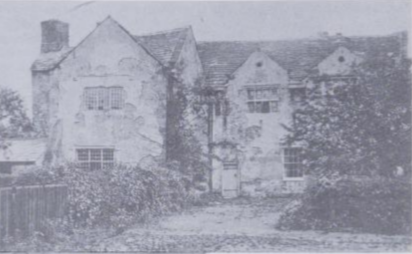
Barton Old Hall
BARTON CROSS – Barton Old Hall, surrounded by a moat, was on the north side of the main road, half a mile south-west from Patricroft, and about one hundred and fifty yards east of Salt Eye Brook.

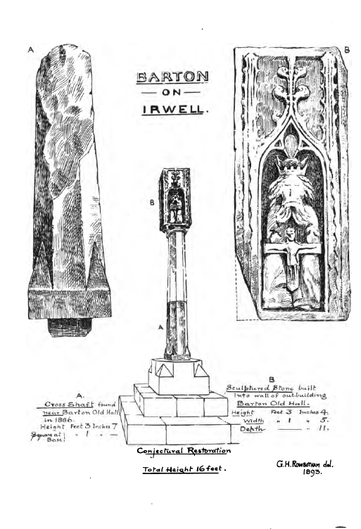
In the volume for 1893 of the Lancashire and Cheshire Antiquarian Society Mr. Rowbotham gives a suggested restoration of an ancient cross which at one time evidently stood near this old hall. In 1886 he discovered a portion of the shaft, which had recently been dug up not far from the hall, close to Salt Eye Brook. The head of the cross, a sculptured stone, was built into the wall of an outbuilding at Barton Hall.
 
Mr. Rowbotham writes:
 
 "The subject of the sculpture is very singular and exhibits the crowned figure of the Supreme seated within a well-carved niche and supporting a crucifix. The trefoil-cusped head of the niche is surmounted by two pinnacles and a central finial ornamented with crockets.  Apparently, the artist intended the principal figure to be represented with hands upraised in the act of benediction, but these members are now lost.
 
Heads of crosses of this type are almost invariably sculptured on all the four faces, and I believe the Barton stone was thus formerly embellished. Two of its faces are buried deep in the old ten-inch brick wall and cannot be examined.In the accompanying restoration I have endeavoured to give some idea of the appearance which this venerable landmark of our faith may have presented, when first it rose above the wayside, close by the edge of the once formidable Chat Moss."

There is some probability that Thomas del Boothe who is said to have built the chapel on Salford Bridge for the repose of his soul, who also founded a chantry in Eccles Church, and who lived at Barton Hall, may have erected this cross. He died in the last quarter of the fourteenth century.
 
(Barton Old Hall was demolished in 1879 and where it once stood is now Gardner and Sons Engineering. The parts of the cross are now said to be in Eccles Parish Church.)

LADY WELL – Cadishead. The partial disappearance of this spring is due mainly to the formation of the Manchester Ship Canal, which caused a disturbance in the natural drainage of the district about fifteen years ago.
 
Mr.Basil R.Tucker, of Cadishead, informs me that in his boyhood the Lady Well was a spring of pure sparkling water of much repute. It is a simple spring, under a hawthorn hedge, staked round with timber. The water used to gush out from a bank of glacial clay and gravel. The meadow opposite bears the name of Mill Hill. The site is about half a mile nearly due west from the village of Cadishead, and the same distance north­ west from the Mersey.
Picture
Original Sketch of the Cross from Barton Old Hall

Local History Update August 2023

3/8/2023


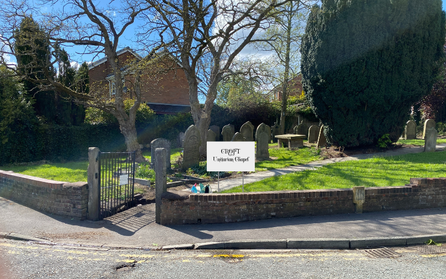
New Sign at Croft Unitarian Chapel

In the next few weeks there will be a new sign erected at Croft Unitarian Chapel on Lady Lane. This is being funded by Croft Parish Council – Thanks to Norman Partington for assisting with this.
Ste Plumb has kindly offered to put up the sign, saving on labour costs. Thank you so much!
Colour photo Croft Unitarian Chapel 2021
A sample sign showing where it will be

Burial Records from Croft and Risley

All of the baptisms and the marriage from the Croft Unitarian Chapel and Risley Chapel register are already available for members to search online at mlfhs.uk. The burials have also now been submitted and will be online soon.
​
It only costs £15 per year to join the Manchester and Lancashire Family History Society. They have thousands of records available and it is a charity run completely by volunteers.


Of course I am also willing to help anybody with requests whenever I am not too busy.

Culcheth Library

Now that Culcheth Library is set to re-open, Livewire have had a change of heart since rejecting my offer of help with a local history section.

They have asked if I would like to be part of a group helping to make the most of the local collections in the library, working with Culture Warrington to see what can be offered. Of course, my answer was yes. I will share any information once I have it.

    Author

    Cheyvonne Bower
    I am a local  and family historian with a passion for the past.
    I am a member of the
    ​Manchester & Lancashire Family History Society.

    Archives

    September 2025
    August 2025
    October 2024
    September 2024
    August 2024
    July 2024
    June 2024
    April 2024
    March 2024
    February 2024
    January 2024
    November 2023
    August 2023
    April 2023
    March 2023
    December 2022
    November 2022
    October 2022
    September 2022
    August 2022
    May 2022
    April 2022
    March 2022
    February 2022
    January 2022

    Categories

    All
    Christ Church
    Civil War
    Crime And Punishment
    Croft In The News
    Croft In The Wars
    Croft Then And Now
    Croft Unitarian Chapel
    Culcheth
    Health
    Information
    Irlam
    Leisure
    Listed Buildings
    Maps
    Newspapers
    On This Day
    People
    Public Houses
    Risley Chapel
    Winwick

Picture
© Cheyvonne Bower 2025
  • Home
  • Places of Worship
  • Local Families
    • The Yates Family
    • The Clare, Warburton and Daintith Family
  • World War Two
  • Gallery
  • Public Houses
  • News
  • Burial Grounds