Croft History
  • Home
  • Places of Worship
  • Local Families
    • The Yates Family
    • The Clare, Warburton and Daintith Family
  • World War Two
  • Gallery
  • Public Houses
  • News
  • Burial Grounds

History
&
​Heritage

Salford Cottage Homes in Culcheth

10/4/2022

 
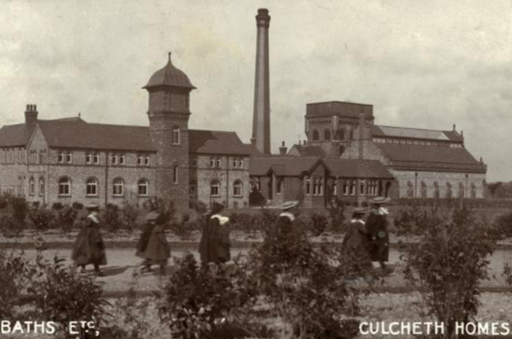
Salford Cottage Homes Culcheth Picture

An Account of the Culcheth Cottage Homes, Written by Rev. Plant in 1928.

The Salford Board (of Guardians) purchased an estate at Culcheth, six miles from Warrington, an unspoiled country district in the healthiest part of South Lancashire in the parish of Newchurch.

The estate, of 46 ¾ statute acres, was purchased in 1899 for £4500. In 1903 the Board erected a group of cottage homes for the accommodation of 288 children and a staff of officers. The building costs were £61, 211 and furnishing an extra £2500.

No pains were spared to make the Colony complete in every way, and the result amply justifies the thoughtful foresight and unselfish labour spent on the project by the members of the Board at that time.

The Colony consists of 22 semi-detached and two detached cottages to accommodate 12 to 14 children in each; a hospital designed in wards to accommodate 32 patients; a detached home for the nursing staff, connected to the hospital by a covered way, and a detached house for the Superintendent.

The object in view when planning this Colony was to provide for the destitute children of Salford – ‘a home away from home’ – a home in the heart of the country, amid ideal surroundings, and away from the overcrowded and often squalid neighbourhood that most of them had known from infancy.
​
The staff and children attend at the Parish Church each Sunday morning at 10:30 a.m., and the rector who is Chaplain of the Homes, prepares them for confirmation, teaches in the day school twice a week, arranges their Sunday School and children’s services, and looks after their spiritual life generally.
Picture
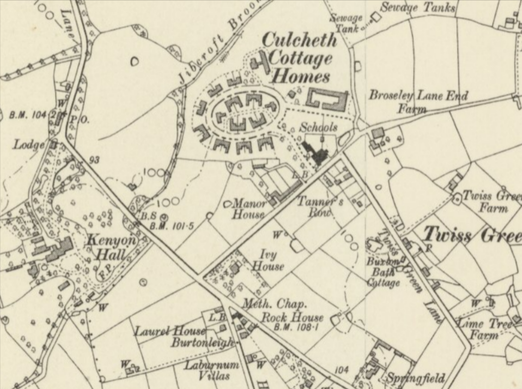
Map from 1913 showing the Culcheth Cottage Homes
In each home are placed not more than 12 children, whose ages range from 2 – 15 years, in charge of a Foster Mother (and in the case of some boys Home of a Foster Father and Mother). Each child has its own separate bed, its own private locker, and its own private toilet utensils.

Uniformity in the Homes is avoided as much as possible, and the Foster Parents are encouraged to exercise their individuality, and while conforming to the general rules of the Colony, to conduct their Homes naturally and spontaneously.

The children attend school until the age of 14 and during this time have every opportunity of physical training, both by definite instruction, and by organised games – special attention being given to swimming, for which a large and handsome bath has been erected.

When a child passes 14 it leaves school, and while remaining in the Colony spends its school hours in one or other of the industrial shops, each of which is under the control of an experienced tradesman or tradeswoman, and where it receives careful tuition, and acquires practical knowledge.

For the girls there are provided a sewing room, well-equipped for all dressmaking, and which supplies the Colony with most of its garments, linen and hosiery, a laundry that affords training in the use of machinery, and in all branches of laundry work, and in addition the Homes themselves furnish tuition in cooking and all domestic duties.

The boys have the choice of the Shoemaker’s Shop, in which all the boot repairs are executed, and a large proportion of new work is undertaken, The Joiner’s shop, in which all renewals of, and repairs to woodwork for the Homes are made; the Bakehouse which supplies the Colony with its bread and cake, the Plumber’s and Engineer’s shop, which provides the Colony with electric light and with water and heat; the Painter’s shop, which is responsible for all decoration and re-glazing on the Colony. Gardening is taught to both boys and girls.

In addition, every boy has the opportunity of joining the brass band.
The numerous centres of activity, together with the large mixed farm, makes the Colony practically self-contained, and it is a rare occurrence to see any outside tradesmen at work in the grounds.
​
The value of the training is shown when the children leave the Homes, and almost without exception they do well and make headway.

Newchurch Hospital

The Homes as an orphanage closed about ten years after this was written and became Newchurch Hospital in 1948.

In 1989, there were concerns for the future of the hospital:

Newchurch Hospital, Culcheth
HC Deb 23 March 1989 

Mr Hoyle - To ask the Secretary of State for Health what is the future of Newchurch hospital, Culcheth, Warrington; and if there are any plans to close it.

Mr. Freeman - Newchurch hospital is in the process of retraction as patients are gradually transferred to care in the community schemes. As the numbers of patients reduces consideration will have to be given to the best way of caring for those remaining. We are not, however, aware of any plans to close Newchurch hospital.
(Source: parliament.uk)

The Workhouse Encyclopedia by Peter Higginbotham has the dates that  Newchurch Hospital operated as 1948 - 1992.

Former staff member Helena Campbell has contacted me with the correct closure date of March 1993. 
​
The site was designated a protected conservation area in 1993. In 1995, permission was granted for conversion of the buildings into private dwellings.

Comments are closed.

    Author

    Cheyvonne Bower
    I am a local  and family historian with a passion for the past.
    I am a member of the
    ​Manchester & Lancashire Family History Society.

    Archives

    September 2025
    August 2025
    October 2024
    September 2024
    August 2024
    July 2024
    June 2024
    April 2024
    March 2024
    February 2024
    January 2024
    November 2023
    August 2023
    April 2023
    March 2023
    December 2022
    November 2022
    October 2022
    September 2022
    August 2022
    May 2022
    April 2022
    March 2022
    February 2022
    January 2022

    Categories

    All
    Christ Church
    Civil War
    Crime And Punishment
    Croft In The News
    Croft In The Wars
    Croft Then And Now
    Croft Unitarian Chapel
    Culcheth
    Health
    Information
    Irlam
    Leisure
    Listed Buildings
    Maps
    Newspapers
    On This Day
    People
    Public Houses
    Risley Chapel
    Winwick

Picture
© Cheyvonne Bower 2025
  • Home
  • Places of Worship
  • Local Families
    • The Yates Family
    • The Clare, Warburton and Daintith Family
  • World War Two
  • Gallery
  • Public Houses
  • News
  • Burial Grounds